
A stone has no reason to remember us.
It was old before the first hand
closed around it,
before we gave hunger a name
and taught the dead
to remain standing.
Still, touch limestone
and you touch an argument
that has outlived its witnesses:
shell becoming sediment,
sediment becoming pressure,
pressure becoming a hardness
we mistake for permanence.
This is how the earth
conducts its slow revisions.
Nothing is finished.
The mountain is only
a sentence taking centuries
to alter its grammar.
Even granite,
with its cold confidence,
contains contradiction—
quartz, feldspar, mica
locked together
without agreeing
on what they are.
Perhaps this is why
I trust stones.
They do not pretend
to be singular.
A river stone knows
that identity is abrasion:
the same body
made unrecognizable
by contact.
You pick one up
and call it smooth.
But smoothness is evidence.
It means something
has spent itself against it.
Water.
Sand.
Ice.
The patient pressure
of other bodies.
We admire the cathedral
for rising toward heaven
and forget its stones
were once buried
under other stones,
forget that every column
is carrying the memory
of weight.
Architecture is merely geology
that has learned
to imitate desire.
A wall says:
I will keep you out.
A tomb says:
I will keep you here.
A monument says:
remember.
The stone,
silent beneath all three,
says nothing.
Or perhaps its silence
is the oldest form of speech.
At night I think of the stones
beneath the city—
buried foundations,
old thresholds,
the chipped steps
of houses no one remembers,
coins pressed into mud,
a child’s marble
waiting beneath a century
of footsteps.
How much human life
can disappear
without disappearing completely?
The body leaves almost nothing.
A little calcium.
A tooth.
A trace of iron
darkening the soil.
Yet a stone remembers
without memory.
Not names.
Pressure.
Heat.
The direction of a fracture.
The violence of being split.
And there is something
almost indecent about this:
that the earth keeps
a more accurate account
of our touch
than we do.
You once placed your hand
against a wall beside mine.
Nothing happened.
No thunder.
No prophecy.
Only the smallest exchange
of temperature—
your warmth entering stone,
stone returning it
slowly, almost imperceptibly,
as though matter itself
had learned courtesy.
Perhaps this is what draws me
to anything that endures:
not that it remains unchanged,
but that contact
makes alteration inevitable.
The stone does not become
less itself beneath the river.
It becomes fluent.
Rounder.
Darker.
Bright with water.
And perhaps we are like this—
not monuments,
not ruins,
but forms continually
made more exact
by what we touch.
Your hand beside mine.
The wall holding its coolness.
Two temperatures
meeting in silence,
and the strange, beautiful fact
that neither of us
has to surrender in order to be changed.
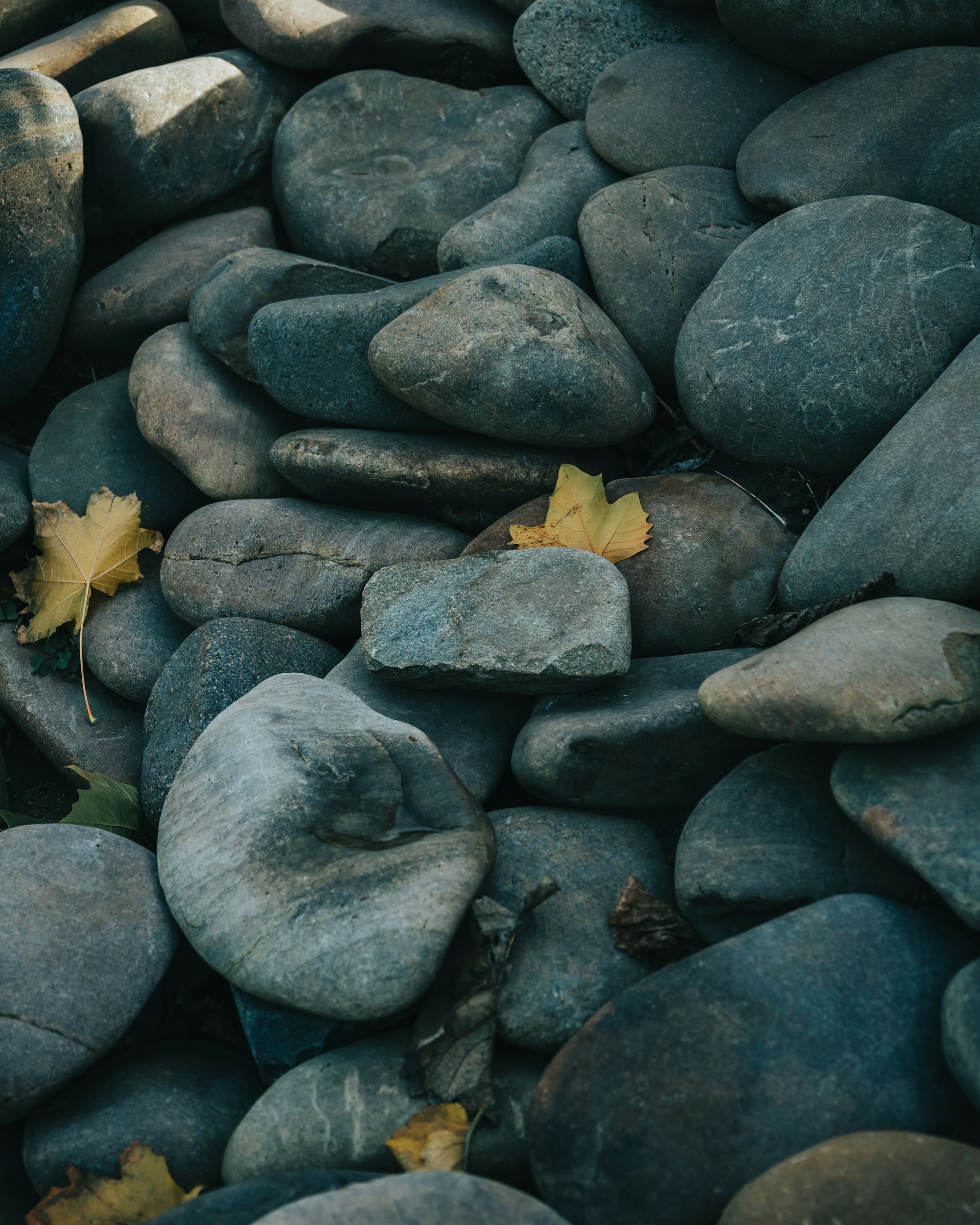
Photo credits: A group of rocks by Tony Litvyak, Unsplash.
Posted for Poetics: Lyric Petrologies @dVerse Poets Pub

26 Responses
This is one of the most phenomenal poems I have ever read. Absolutely incredible work.
Thank you so much, Shawna 😀 so glad you liked it 💄❤️
Never was a title more fitting, Sanaa! So many permutations of thought and feeling evolving here that (like the warm hand on cold stone you write of) transfers a measure of heat and raw energy, a tension and a release that is at once moving and profound. A strong meditation on life and stone and love and grandeur and memory, all of which find their meaning in the touch, the presence of the other. I feel like this poem is like a stone wrapped in light. Illuminating, and wonderful.
Thank you so much, Dora 😀 so glad the poem resonated with you 💄❤️
(and thank you for the glorious prompt) 🥂
This is really wonderful, Sanaa! You have given stone and change a whole new perception! This is so good…
pressure becoming a hardness
we mistake for permanence.
Or perhaps its silence
is the oldest form of speech.
Thank you so much, Dwight 😀 so glad you enjoyed it 💄❤️
Very nice Sanaa, an epic journey and testament to the resilience and wisdom of stones! Beautiful poem! 🩵
Thank you so much, Cara 😀 so glad you liked it 💄❤️
Beautiful!
Thank you so much, Jay 😀 so good to see you 💄❤️
What a wonderfully perceptive poem – really makes the reader think – Jae
Thank you so much, Jae 😀 so glad the poem resonated with you 💄❤️
I saw the title and thought, Sanaa, you’ve done it again! What an amazing epic poem, so beautifully written. The first stanza wowed me and then I was wowed again and again. Yes, that is ‘ how the earth conducts its slow revisions’, like a poet only ‘Nothing is finished. The mountain is only
a sentence taking centuries to alter its grammar’. And these lines:
‘You pick one up
and call it smooth.
But smoothness is evidence’
and
‘A wall says:
I will keep you out.
A tomb says:
I will keep you here.
A monument says:
remember.
The stone,
silent beneath all three,
says nothing.’
The whole poem is stunning!
Aww gosh! Thank you so much, Kim 😀 so glad you enjoyed it 💄❤️
This is an amazing piece of poetry, you draw so much from the history of stone and stones, building up to wonderful way as a metaphor. Geology has never been more attractive.
Thank you so much, Bjorn 😀 so glad the poem resonated with you 💄❤️
Sanaa, one of your best poems, if not your finest. Your skills shine in it. Please put this one in your special folder.
Thank you so much, Lisa 😀 so glad you liked it 💄❤️
Sanaa, this is quite simply an astonishing piece. Absolutely stunning, from title to end line. I started to list some of my favorite lines, and then realized I’ll be cutting and pasting practically the whole thing. So.SO.Gooood.
Thank you so much, De 😀 so glad the poem and its imagery appealed to you 💄❤️
Wow! This awesome, Sanaa
“We admire the cathedral
for rising toward heaven
and forget its stones
were once buried
under other stones,”
Much love
Thank you so much, Gillena 😀 so glad you liked it 💄❤️
Much love back
Superb. I love this poem. I was drawn in immediately. So many strong, interesting statements. A remarkable way to define intelligence.
Thank you so much, Maria 😀 so glad you enjoyed it 💄❤️
Or perhaps its silence
is the oldest form of speech.
So many wonderful lines, but this one spoke to me deeply.
Thank you so much, Paul 😀 so glad the poem resonated with you 💄❤️